August 26 is Women’s Equality Day! This day commemorates the passage of women’s suffrage in the US. It reminds us of the hurdles overcome by the heroic women who faced violence and discrimination to propel the women’s movement forward. In celebration, we decided to speak to a few Casey Trees ladies about workplace equality and its meaning to them.
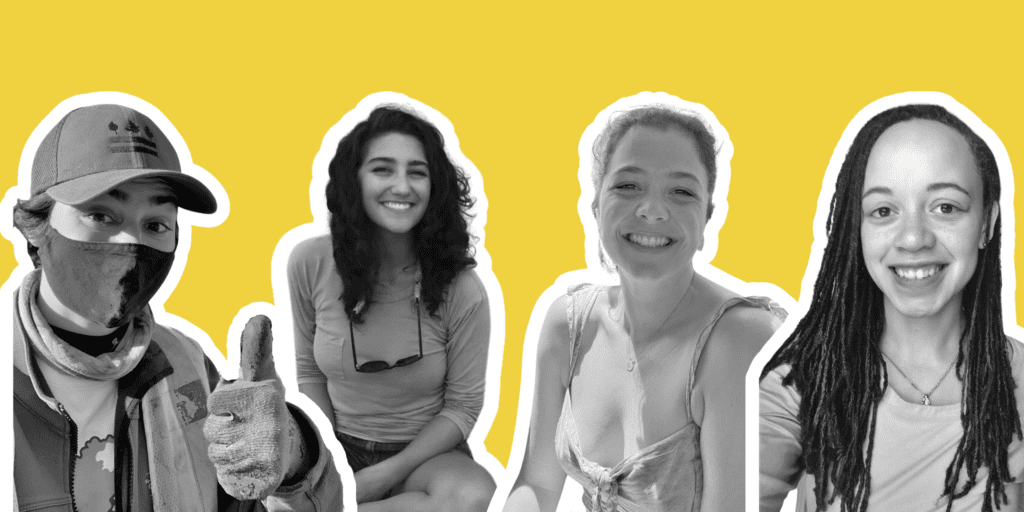
Casey Trees (CT): Hey there! Happy Women’s Equality Day. What’s your name, and what do you do at Casey Trees?
Gaby Elliot (GE): My name is Gaby. I’m the Urban Forester for Casey Trees.
Deanna Higgerson (DH): I’m Deanna, and I am the Nursery Admin Assistant for the Casey Trees Farm.
Michaila Musman (MM): My name is Michaila, and I am the GIS Manager at Casey Trees. My team and I manage our database of trees, create maps and data visualizations, and
make our data more accessible to people inside and outside of Casey Trees.
Kelsey Desmond (KD): I’m Kelsey Desmond, the Youth Programs Manager at Casey Trees.
Alex Kew (AK): I’m Alex Kew, our Communications and Events Manager at Casey Trees. My job is to manage all our outward-facing events and run our volunteer program – so that means you can find me at any of our tree care or planting events this fall! I started at Casey Trees as a Crew Chief on our Tree Operations Crew, and after a few seasons, I transitioned to our Communications team.
CT: What does equality mean to you?
GE: To me, equality in my field means the opportunity to contribute to a cause I
believe in, and for [the opportunities] to never be withheld from me based on my sex or gender. The goals we have at Casey Trees are big ones; they require all hands on deck!
Equality means everyone can contribute their strengths to the cause.
DH: Equality to me means having the same opportunities and being able to obtain them according to what and where I want to be while being mindful of my strengths and skill set
CT: What does it mean to you to be a woman in forestry/nonprofits?
MM: I think being a woman in forestry, and GIS/Data Science specifically, means
creating more opportunities for the women who come after me. I have been
very lucky to have great women mentors, and I hope to be that for younger
women in the future.
AK: Being a woman in forestry and the environmental sector is really important to me. I’ve always had a passion for environmentalism and hands-on work, but often in joining those fields, I’ve discovered them to be primarily male-dominated.
When I joined the crew here at Casey Trees, I was the only woman on a team of strong tree planting men. It was a steep learning curve, and when I started, I certainly couldn’t move trees and dig holes as fast or as effectively as any of them.
But I stuck around. And after a little time and a lot of dirt, I was right on track with them. I’ve learned that these industries need more women and more diverse voices, and though it may be hard initially breaking in and doing the work – it’s always worth it to keep pushing for what you believe in.
KD: I feel very lucky that I work in environmental education. This field is actually
female dominated. It brings together the hard science of forestry with the
people-orientation of education. I love when people of multiple gender
expressions come together and share their lived experience. I think we can
all rally around love for the natural world.
One of the best teams I have ever been on has been the Education team
here at Casey Trees. Our department was primarily women, and we would get into a great productive flow together. I felt like my ideas were supported, and that I could trust my team to give me constructive feedback that bolstered my work. I make a lot of effort to contribute to a culture of regular feedback, play, and collaborative learning. My team makes me feel like I can come to work with my whole, authentic self.
CT: What challenges/cultural barriers are important to overcome in women’s
equality?
KD: I would be remiss if I didn’t mention the racism, classism, and ableism as
barriers to women’s equality. Certainly, forestry is a male-dominated field,
but it is also predominantly white. A recurring conversation in my
department is how we make our field attractive to young BIPOC (Black and
Indigenous People of Color) and how they can feel like the outdoors is a
place they can feel safe and inspired.
I recognize we have a painful history in the United States, where the
outdoors and specifically forests are unsafe spaces for women and people of
color. Further, many WOC feel excluded in environmentalist spaces. Barriers
to women-exclusion from professional and academic spaces, regressive
gender roles etc.-interlock with barriers to people of color, disabled people,
and other folks oppressed.
CT: Any advice to women who might be scared or nervous to join a “man’s industry”?
GE: Remember that being a woman in a male-dominated industry isn’t a liability
– it’s an asset! Diversity in urban forests increases resilience, productivity,
and interest. The same is true of the workplace!
MM: There are so many women that are excited to mentor women who join this
field, and there is absolutely a place for you in this industry! There is a real
comradery among women in forestry (and GIS!), and you have so much to
offer the forestry/GIS field. You don’t have to look, speak or act less
feminine to be taken seriously and be great at your job!
AK: Do it anyway.
Do it anyway, and do it scared! Bravery is born not by doing things you are already confident in but by doing the things that scare you. Just because a field may be “traditionally male-dominated” doesn’t mean there isn’t room for you – and in fact it often means there needs to be more room made for you.
We need more women and people of all genders in all fields. When an industry is so dominated by one group of people, progress can stall, and things end up staying the way they are. Diversity and encouraging new ideas are the stepping stones that make every industry grow and expand, in fact it’s what makes everything grow and expand.
It can be scary approaching a field with a history of being dominated by men. But the only way to break these barriers and bring your unique perspectives to the table is to take a seat. So, pull up a metaphorical chair and start making change. And, when you see other women eager to join you, invite them in. The only way we make progress in this world is by uplifting and empowering each other.
DH: If I could give a few points –
- Know thyself first. We all have strengths and weaknesses. For example, I recognize that I would never want to sit at the table to make important decisions, but I can be an incredibly supportive asset to those who do.
- Maintain integrity. A great visual reminder to this would be the rows of trees on the farm. Every tree has a specific place and row. Don’t worry about what the next row is doing. You do YOU!
- Don’t take anything personally, and if you do; consider the source from whence it came. Learn to zoom way out of the conflict, take your emotions out of it and take another look down at from a satellite level. Things look different from that perspective.
- Practice self-care. Schedule it if you must. You matter. Treat yourself like you would your best friend and make no apologies to anyone for doing so.
- Have fun with it! Express yourself. I love fun, colorful footwear… and I try to be matchy-matchy with my boots/outfit at work which brings a little life to kind of drab (but sensible) work wear. Not only does the farm crew get a chuckle, but when I’m stopping at a location outside of work and someone compliments my boots, I don’t hesitate to say with a smile, “Thanks! I work on a tree farm!” (And if there are youngins around, I make sure they hear too!)