A few weeks ago, we checked in with two of our awardees of the Garden Club of America (GCA) Zone IV Fellowship in Urban Forestry, an annual fellowship awarded to one or more students to support study and research involving urban forestry. We heard from Advyth and Mary-Margaret about the fascinating work they’ve done, including investigating the cooling properties of urban tree species and developing methods to predict the onset of fall senescence.
Today, we’re following up with our final two fellows: Kendall McCouch and Taylor Sherer. Keep reading to learn about these awardees’ research and how they’re advancing the field of urban forestry!
Tree Growth Response to Variable Urban Climate Informs Urban Forest Carbon Storage Potential
Kendall McCouch
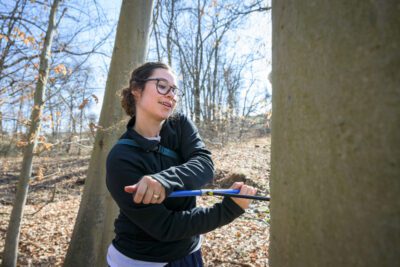
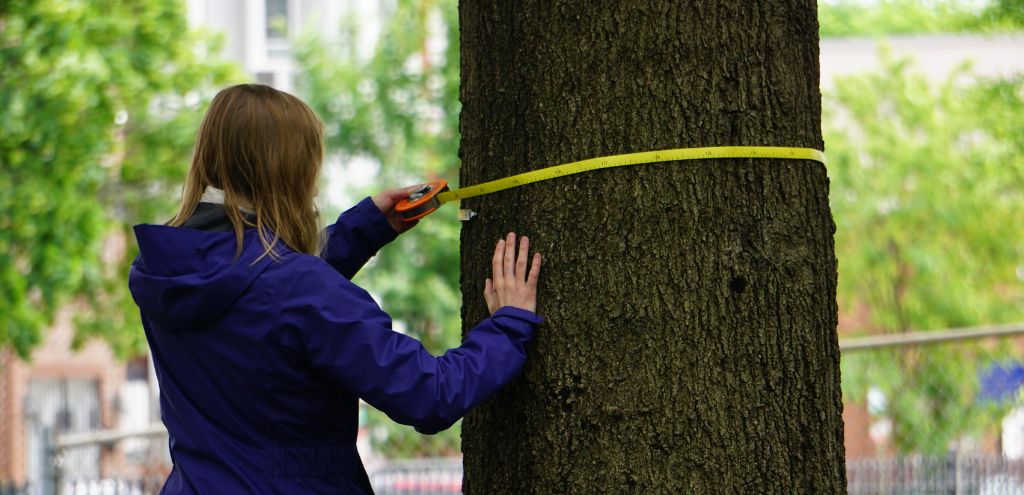
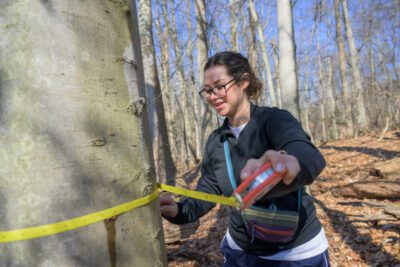
Using tree ring analyses and climate change data from urban forests across the Mid-Atlantic, Kendall’s project aims to determine how tree growth relates to urban temperature and precipitation patterns over the last century. Growth records for Baltimore, MD, Newark, DE, and Philadelphia, PA are compiled from rings on tree cores, which are then compared with climate variables to understand how tree growth in urban forests responds to their surrounding climate. Kendall’s research seeks to use this understanding to determine the capacity of an urban forest to provide ecosystem services, including carbon storage.
What inspired you to choose your research topic?
I’ve always been interested in natural environments, particularly forests. My passion for the environment and concern about climate change converged with my desire to conduct research and led me to pursue a doctoral degree in plant science with a focus in urban forest ecology. My advisor introduced me to dendrochronology as a method to answer questions about tree growth and climate, and I’ve been absorbed in the field ever since.
Do you have any highlights from your research or the field?
My best “fun fact” about my research is that the oldest tree I’ve sampled predates the founding of the United States by 32 years – an oak tree from Baltimore dating to 1744.
And there are always unexpected “highlights” from the field. For example, one day while coring a tree after a rainstorm, the water pressure inside the tree built up to the point of explosion, and a stream of water shot the core sample from the inside of the tree out of the borer like a projectile, which is very hard to do. (Both the tree and the core sample were fine).
Have you learned anything new that’s surprised you?
Everything I’ve learned over the course of my research has been a discovery for me! One of the most interesting topics I’ve learned about is wood anatomy and the process of tree growth. Conducting tree ring analysis requires an understanding of how carbon is moved from our atmosphere and stored in the trees’ roots, leaves, and wood. In a way, when I’m looking at the tree rings in my samples, I’m looking at the result of that process.
My results on how tree growth has responded to climate over the past century are among my most interesting findings; trees in urban forests exhibit species-specific responses to precipitation and temperature. For example, tulip poplar, a fast-growing, abundant species in our eastern temperate forests, is extremely sensitive to precipitation.
What interests you about urban forestry?
As cities and suburban areas expand, the intersection of our human-built environment and the natural world becomes more complex and widespread. Forests in urban areas are abundant, accounting for a large portion of the temperate forest in the eastern U.S., and are important, providing critical ecosystem services like climate regulation and wildlife habitat, in places where there would otherwise be none. But often, these spaces are overlooked by the very residents they serve.
The unseen role these forests play, and their critical value to humans and wildlife, is what makes urban forestry so interesting to me.
Assessing Nursery Stock Quality and Early Tree Care of Live Oak in Florida
Taylor Sherer

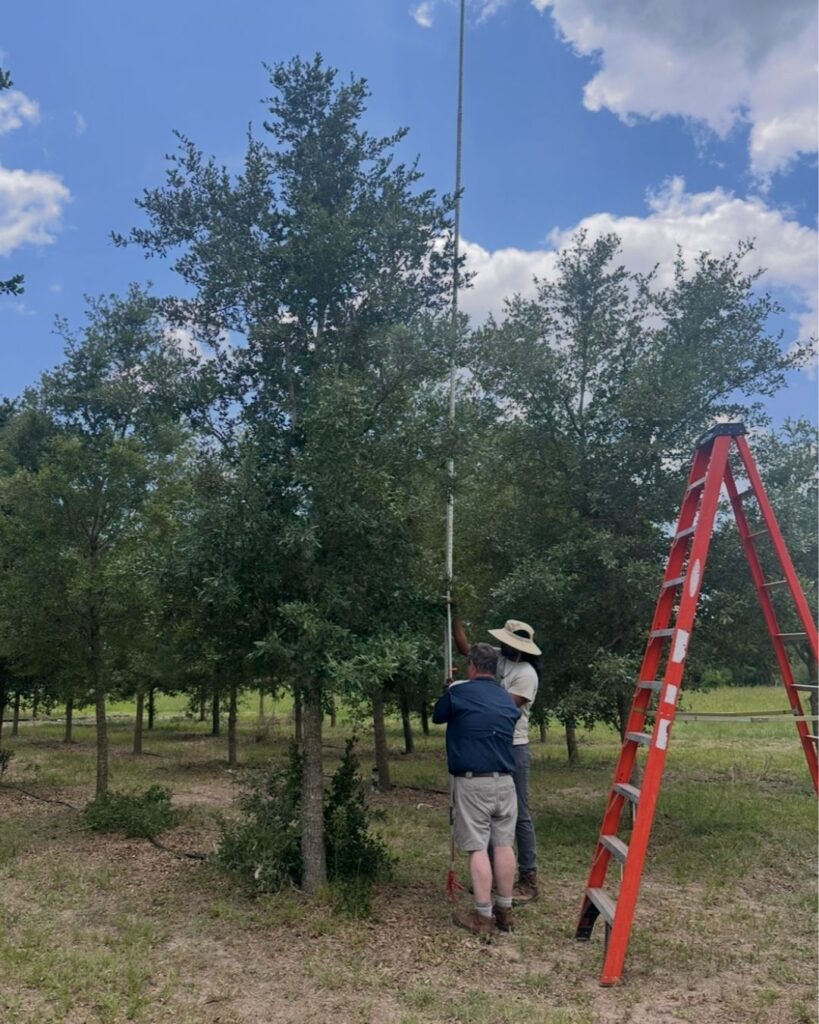
Taylor’s research focuses in Florida, where she works to evaluate the variability of nursery tree stock quality among growers and sellers. Her work combines the science of trees with social realities, comparing field data with real market behaviors exhibited by tree stock consumers, including homeowners and green industry professionals. Taylor’s study aims to provide insights into the practices and preferences that influence the longevity of trees planted in urban landscapes.
What inspired you to choose your research topic?
As an M.S. student, the condensed nature of the program required me to build upon an existing research plot established before I joined the university. To expand the project’s scope, we integrated a social science component to assess how homeowners engage with the portion of the urban forest located on private property. We also surveyed green industry professionals across Florida to better understand variability in tree care practices, professional priorities, and perceptions of urban tree management.
Do you have any highlights from your research or the field?
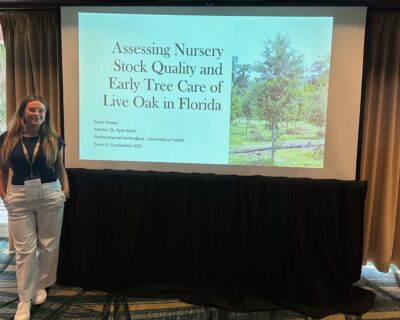
Since joining the M.S. program at UF, I have had the opportunity to share my research at conferences and professional development events. Engaging directly with experts in the field has broadened my understanding of urban forestry and fueled my drive to actively contribute to advancement in our discipline. My experience as a graduate student has transformed my initial curiosity into a strong commitment to creating sustainable, resilient cities.
Have you learned anything new that’s surprised you?
Through this research, I’ve learned that both homeowner behavior and professional standards vary widely, and that early tree care practices have lasting impacts on urban forest health.
What interests you about urban forestry?
When I began my research career, I did not intend to concentrate on urban forestry. As an undergraduate, my work centered on crop physiology and evolutionary ecology, but I was always driven by a deep passion for plants and sustainability. That passion guided me to the Environmental Horticulture Department at the University of Florida, where Dr. Ryan Klein invited me to join his lab as a master’s student.

At the time, my knowledge of forestry and urban ecology was limited, but after our initial meeting, I began exploring the field on my own. It was through this exploration that I discovered the remarkable interconnectedness between plant ecology, urban sustainability, and societal well-being that defines urban forestry. In my future career, I aspire to contribute to urban environments that balance ecological integrity with human well-being, fostering communities that are both sustainable and more resilient.
Thank you to Kendall and Taylor for sharing their insights and research with us! And if you haven’t already, be sure to check out our previous article featuring the rest of our GCA awardees.
By placing students at the center of this research, we’re investing in the ideas and solutions that will shape the urban forestry field for years to come.
Inspired by what you’ve read and looking to make an impact of your own? Applications are open for GCA’s 2026 Zone IV Fellowships! Open to students pursuing advanced studies in urban forestry, environmental studies, and other related fields.
Learn more on our page and apply today!