Weekly Watering Alert
The watering alert for August 17 – August 23, 2026, is Consider Watering. Forecasted storms later in the week should bring a good amount of rainfall to the DC area. However, it may fall short of the amount of water young trees need. Monitor for actual rainfall this week and water trees as needed.
Sign up for the Leaflet to receive our weekly watering alerts.

Watering Alert Key
Water Not Needed – Recent or predicted rainfall exceeding 1.5 inches this week. Trees have enough water.
Consider Watering– Trees may need water, depending on the forecast. Check trees for signs (wilting leaves and/or dry soil) and water as needed. See watering guide and FAQs below for more guidance on how to water.
Must Water – Not enough rainfall is observed or forecasted this week. Young trees must be watered.
Watering alerts are determined using NOAA/National Weather Service’s observed and predicted precipitation amounts, drought monitoring, and local forecasts for the DC metro area.
WATERING IN A DROUGHT
Recently, the Metropolitan Washington Council of Governments (COG) announced a drought watch following unusually dry conditions, and residents are encouraged to conserve water.
Here are a few tips for watering young trees responsibly during a drought:
- Water in the early morning or late evening to ensure your plants soak up the water before the water evaporates during the hotter times of the day.
- Water slowly to prevent water from running off onto the sidewalk or street, and water deeply and infrequently to encourage resilient, deep root systems.
- Apply a mulch ring at the base of the tree (but don’t volcano mulch!) to help retain moisture and avoid runoff.
For more tips on conserving water outside and inside your home, visit DC Water.
How to Water
Healthy trees start with consistent care — and watering is one of the simplest yet most important ways you can help them thrive. With the DC region’s hot summers and variable rainfall, young and newly planted trees depend on regular watering to establish strong roots and withstand stress from heat, drought, and urban conditions.
Especially in the first two to three years after planting, trees rely on you to supplement what rain does not provide. Trees should be watered consistently from early spring to late fall (April 1 – October 31), up to 25 gallons of water (approximately 1.5 inches of rainfall) per week. Whether you’re caring for a tree in your yard, neighborhood, or local park, every gallon makes a difference.
Watch our video below to learn how to water, and see our watering FAQs for any other questions you may have.
En español: Riego de árboles
By following clear guidelines on when, how much, and how often to water, you help trees establish strong root systems, withstand heat and drought, and grow into the healthy canopy that keeps DC cooler, greener, and more resilient.
Watering Essentials
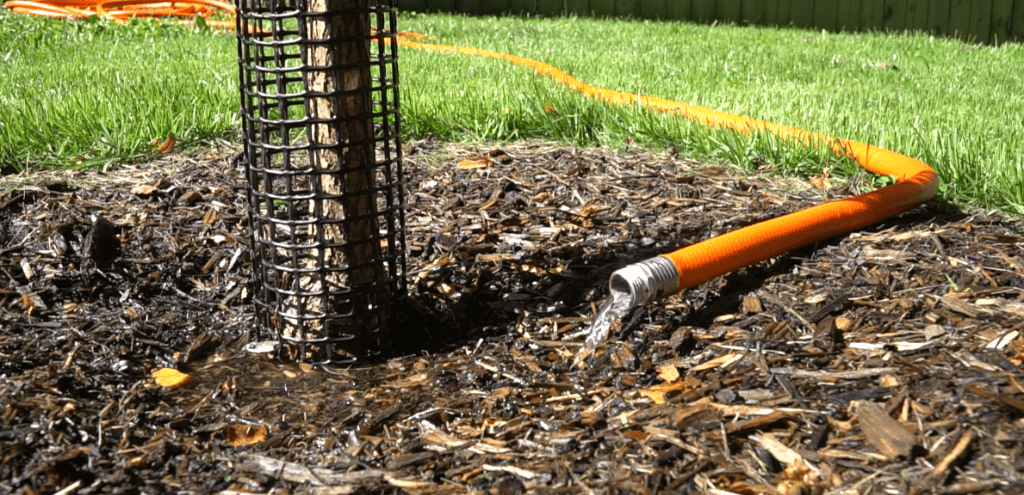
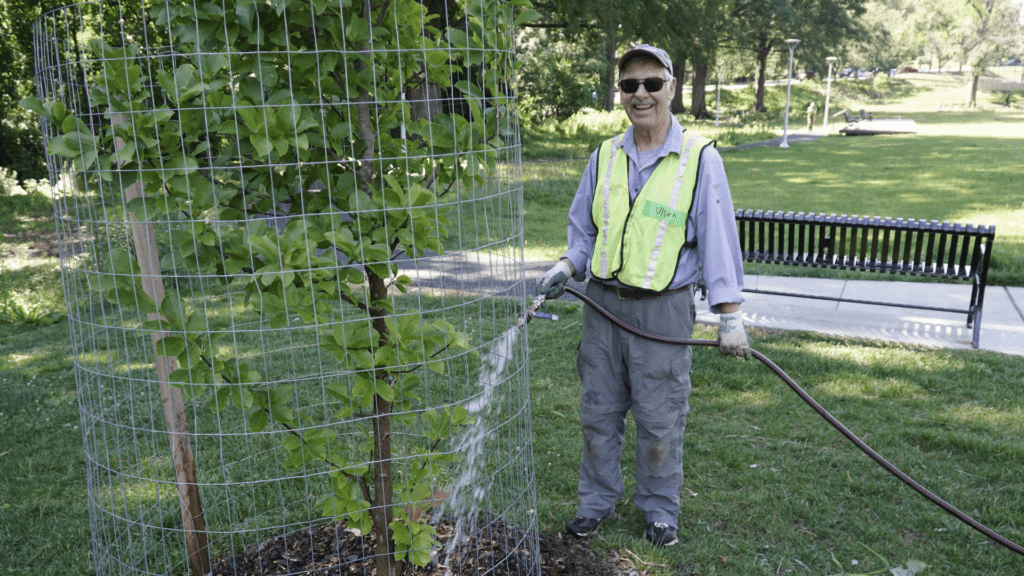
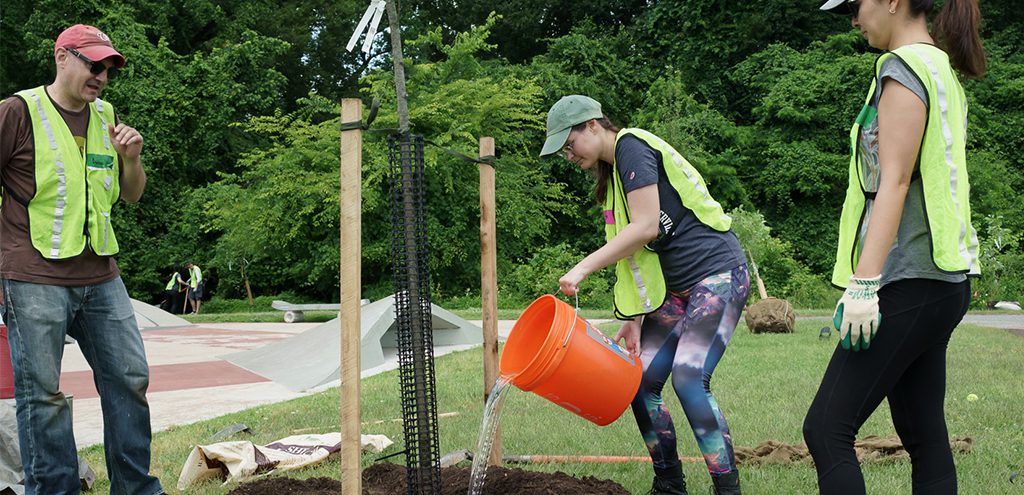
The easiest way to water trees is to slowly soak the soil around the roots and base with a garden hose. Ensure the water penetrates deeply rather than running off the surface. Water once per week under normal conditions, increasing to two or three times weekly or as needed during droughts or extreme heat. Avoid wetting the leaves or trunk—direct water only to the root zone for better absorption. For a simple alternative, repeatedly fill and empty a 5-gallon bucket at the tree’s base until the soil is thoroughly moistened.
Trees need approximately 10 gallons of water per inch of base trunk diameter, per week. Casey Trees often plants trees that are at least 1.50” in caliper (i.e. the trunk’s diameter is at least 1.5 inches), and thus require 15 gallons of water per week. But many trees may need up to 25 gallons of water (approximately 1.5 inches of rainfall), per week.
It is essential to water slowly, especially when the ground is hard and dry. Water should soak into the soil; if too much is applied too quickly, it will run off. If possible, place a hose a foot or so from the base of the tree and turn it on to a slow trickle. Let it run for about 30 minutes (set a timer for yourself), occasionally moving the hose nozzle to water the entire root zone of the tree. If you have a small sprinkler head, you can use that to cover a wider area – but again, turn it on low. You can also water with a five-gallon bucket that you have drilled 3-4 holes in the bottom, about the diameter of a pencil lead. Place the bucket at the base of the tree, fill it to the top with water, let it drain, move it slightly, and refill it – up to five times.
Frequently Asked Questions (FAQs)
When should I water my trees?
Water early spring to late fall (April 1 – October 31). The best time of day to water is early morning or late evening. Watering during the day results in losing much of the water to evaporation.
Do I need to water my trees in winter?
In general, trees do not need to be watered in the winter. However, if a tree is planted in the winter, we do recommend watering initially to help establish the tree and settle the soil.
As fall turns to winter, you can stop watering trees that have lost their leaves, as the trees have gone dormant in anticipation of the winter months. Note that evergreen trees do not need water during the winter months, even though they keep their leaves. You can resume watering trees in the spring when temperatures are regularly above 50 degrees.
How much water do my trees need?
Trees need approximately 10 gallons of water per inch of base trunk diameter, per week. Casey Trees often plants trees that are at least 1.50” in caliper (i.e. the trunk’s diameter is at least 1.5 inches), and thus require 15 gallons of water per week. But many trees may need up to 25 gallons of water (approximately 1.5 inches of rainfall), per week.
Should I use a watering bag?
Slow-release watering bags can be helpful to aid in slow watering a tree. Casey Trees used to install watering bags with trees but stopped this practice for environmental reasons (less plastic use). It is possible to water trees sufficiently without watering bags. And while watering bags can be helpful, they can also damage a tree’s trunk if not adequately maintained or left on a tree to maturity. If you can thoroughly water your tree without the aid of a watering bag, we suggest that as the best practice.
Do mature trees need water?
While young trees (trees planted in the last 3 years) are most vulnerable, mature trees may also need help in periods of drought. Street trees may be especially susceptible. If you have street trees in front of your home, letting a hose drip onto their roots for a few hours will be a big help! Move the hose nozzle around every hour or so to water the entire area.
The root zone of a mature tree can be very large and extend far beyond the canopy of the tree. The critical root zone, where the majority of roots are located, can be calculated by multiplying the diameter of the tree by 3-5 times. Watering should be concentrated in this area and applied using a slow-release method.
Do some tree species need more water than others? Why?
The tree species we select and plant as urban trees have evolved in a variety of environmental conditions over time and can differ in their characteristics and needs. Some species adapted to wetter soil conditions near rivers or in low forest areas, like river birch or tulip poplar, and require more water to maintain proper plant function. Many oaks and pines have adapted to drier conditions and can tolerate lower soil moisture while maintaining their function. Leaf morphology, wood characteristics, and tree physiology can all be species-specific and influence the water needed for a tree species.
Should I mulch around my trees?
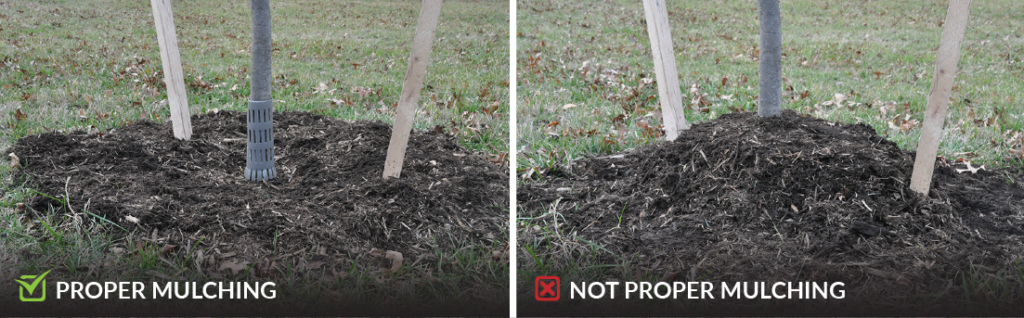
Mulch keeps the water in the soil feeding the roots by slowing evaporation. Place a mulch ring around the tree following the 3-3-3 rule: create a ring of mulch about 3 feet wide and 3 inches deep, leaving a 3-inch space right around the tree trunk. Remember to donut mulch, not volcano mulch – piling mulch against the trunk results in poor tree health.
I am still unsure if my trees need water – what should I do?
The best way to ensure a young tree stays healthy after planting is to keep it well watered. When unsure, choosing to water is often the best choice. If you are still concerned, you can check soil moisture. Moist or damp soil is fine. If the soil feels dry, water the tree thoroughly. Water should soak into the soil. Although overwatering is not common, trees should never sit in a puddle of water for an extended period. This can lead to root damage.