Every year, Casey Trees—in partnership with the Garden Club of America (GCA)—administers the GCA Zone IV Fellowship in Urban Forestry, a fellowship awarded to one or more students to advance the field of urban forestry and increase the number of scientists in the field.
Open to students pursuing advanced studies in urban forestry, environmental science, and other related fields, this fellowship provides up to $7,500 to support study and research topics selected by the awardees, placing students at the center of this exploration.
Today, we’re checking in with two of our awardees: Advyth Ramachandran and Mary-Margaret Benware. Read on to learn about their research and updates from the field!
Finding the Best Tree Species for Cooling Cities: Revealing the Role of Tree Traits in Boulder’s Urban Forest
Advyth Ramachandran
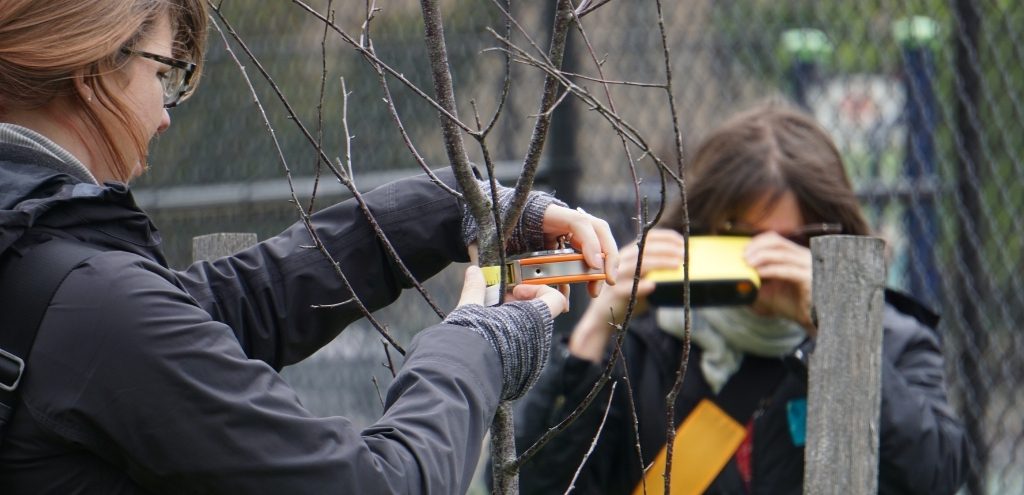
Based in Boulder CO, Advyth’s project investigates the role of tree species in heat reduction benefits from the city’s urban forest. Cooling effects of urban trees are quantified using air temperature sensors, helping identify which species provide the most cooling on average. Traits of each tree species are then measured to determine which traits of species may be providing the highest cooling benefits. With this trait-based approach, Advyth’s research aims to help urban foresters select ideal species planting palettes to help cool cities.
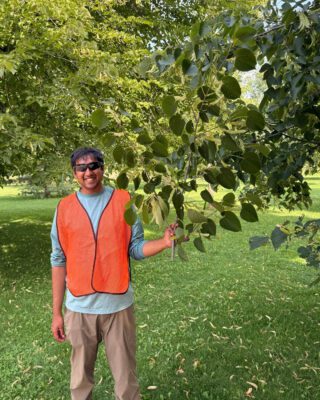
What inspired you to choose your research topic?
I’ve always been passionate about urban trees and noticed their impacts on the local climate of my hometown, San Jose, a hot, inland city in California. But growing up during a megadrought, I also became interested in trade-offs between water use and growing urban canopies to cool urban areas. I began to think about different species of urban trees and how they differ in terms of their drought and heat tolerance.
In my undergraduate and graduate research, I began to learn about functional traits – these measurable properties of plants that vary across species. My research topic came about when connecting these dots – could we use functional traits to select species to plant in urban forests that can cool and reduce heat? To answer this, we first had to test if species are different in their cooling impacts on air temperature – something that is poorly understood.
Do you have any highlights from your research or from the field?
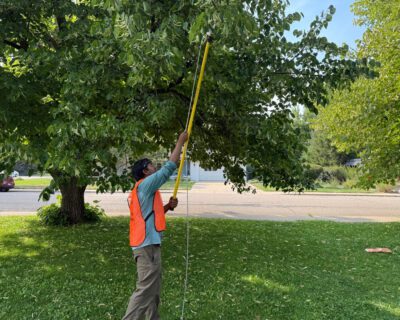
After two years of study, installing and maintaining 120 air temperature sensors across over 150 trees, and controlling for multiple confounding factors, we did find that tree species differ in their average air temperature impacts by up to 2º Fahrenheit. Trees of the same size, but of different species, could have very different microclimates underneath their canopies. This means that when you walk under trees of different species, you can feel different air temperatures!
Have you learned anything new that’s surprised you?
My undergraduate research assistants and I have learned so many things in the course of this project! Two things stand out:
When we were finding trees to place sensors under, we had some challenges figuring out which tree was which. We used the City of Boulder tree database to select trees, so we were walking around looking at digital maps to find our chosen trees. One thing we realized is that Picea pungens (Colorado blue spruce) and Abies concolor (white fir) can look really similar, especially in urban settings. But we learned that the scent of their needles, when crushed, is totally different! White fir smells like citrus, while blue spruce smells sweeter, with an odor reminiscent of Christmastime. It’s cool when chemical characteristics can help you tell tree species apart!
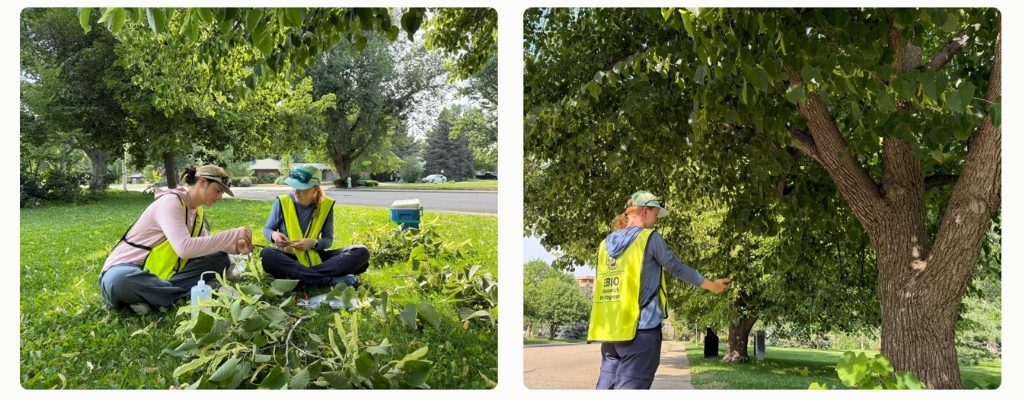
We also learned a lot in the lab working with our urban trees. Looking under microscopes to measure stomatal density (the density of pores in leaves through which plants lose water and take in air), we got to see such a diversity in stomatal shapes. Some trees have long elliptical stomata, while others have circular ones. We also learned to tell the difference between resin ducts and stomata, which can look similar under a microscope. Lots of hands-on biology at work in this project!
What interests you about urban forestry?
I love studying the ecology of the places that people live in and experience every day. Urban forests are complex ecosystems that are part-wild and part-designed by people. It’s a very fascinating topic to study because scientific findings about urban forests can be directly applied to inform tree planting and management. My research interests in urban forestry focus on the biophysical benefits of urban forests – temperature reduction and water use. I think that by quantifying these processes, we can grow healthy, resilient, and functional urban forests.
Linking Nonstructural Carbohydrates and Phenology Across Scales in Urban Trees
mary-margaret benware
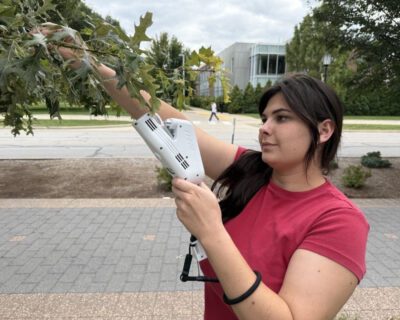
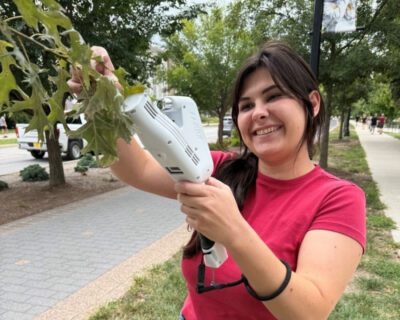
Mary-Margaret’s research seeks to develop digital and physiological methods to predict the onset of autumn senescence—when leaves begin to change color and fall—in urban trees. Her techniques involve measuring nonstructural carbohydrate (NSC) content within leaves, such as sugars and starch, along with collecting spectral images of the trees’ leaves. This study builds upon recent research suggesting that leaves can accumulate NSCs throughout the growing season until they reach a threshold, at which point they begin senescence. By investigating this relationship between the onset of fall color and NSCs, Mary-Margaret’s project aims to improve understanding of carbon cycling in urban areas, especially given the impact of the urban heat island effect on trees.
What inspired you to choose your research topic?
I have always enjoyed being in nature and observing local biodiversity, which has motivated me to pursue my undergraduate degree in biological sciences with a concentration in ecology, evolution, and conservation. During my undergraduate studies, I was involved in research investigating the impacts of different biotic and abiotic stressors on agricultural systems. Through this experience, I found my love for plant biology and my interest in human-modified ecosystems. This inspired me to study urban tree physiology for my PhD research topic, providing me with the opportunity to connect my research in plant physiology to an applied system shaped by anthropogenic impacts.
Do you have any highlights from your research or the field?
My research highlights how tree species respond differently to the urban environment. Characterizing these species-specific responses will be especially important for understanding physiological strategies that plants employ to combat stress from urbanization. Identifying which species are more resilient can advise species selection decisions for tree planting within urban areas.
Have you learned anything new that’s surprised you?
During the course of this project, I have learned new lab procedures and field measurement techniques that allow me to capture seasonal variation in plant physiological traits. I have found it fascinating that trees are constantly undergoing physiological changes that are not easily observable to the naked eye and require further chemical analysis to uncover dynamic patterns.
What interests you about urban forestry?
Urban environments pose unique stressors for trees that inhabit these areas. I am particularly interested in how trees physiologically respond to higher temperatures caused by the urban heat island effect. I am extremely motivated to research urban trees, as they provide important ecosystem services to cities, including carbon sequestration, biodiversity support, and cooling.
A huge thank you to Advyth and Mary-Margaret for taking the time to share their impactful work with us!
By investing in these students’ knowledge and curiosity today, we’re helping shape the field of urban forestry for tomorrow.
Interested in what you’ve read and itching to do some research of your own? Applications are open for GCA’s 2026 fellowships! Learn more on our page and apply today.