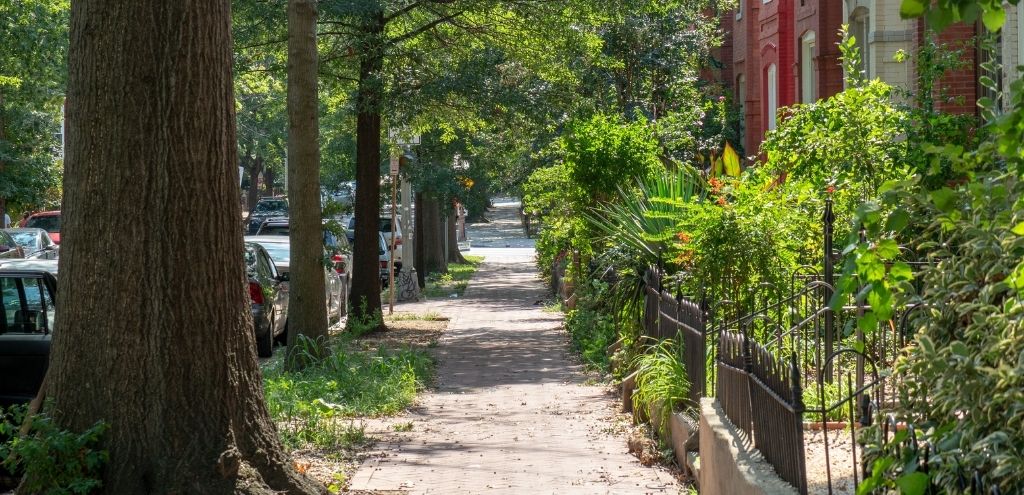
Many of us already know about the benefits of trees and green spaces: improved air quality, better mental and physical health, and stormwater management. But what if trees and green spaces could be as crucial for public safety as installing a streetlight?
A growing body of research suggests they are.
In a groundbreaking 2001 study of the Ida B. Wells homes, located in the southside of Chicago, Professor William C. Sullivan and Associate Professor Frances E. Kuo at the University of Illinois were the first to uncover a positive correlation between access to green space and a lower risk of crime. They found that buildings with high levels of vegetation had 52% fewer total crimes than buildings with low levels of vegetation.
That pioneering research opened the floodgates for similar studies across the country.
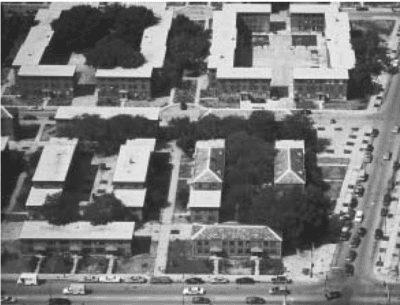
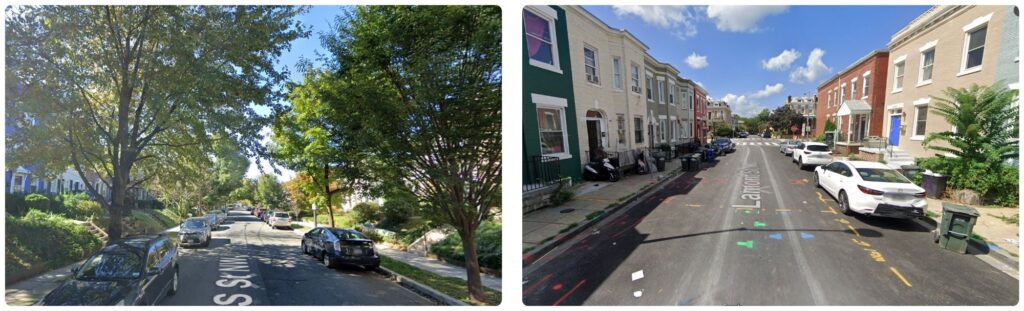
Almost 25 years since that initial study, numerous studies have replicated their work, finding that areas with more trees and vegetation experience less crime and violence—contrary to myths that trees promote crime.
For example, one 2018 study found that an initiative in Portland, OR to plant new trees in underserved communities led to a reduction in violent crime, with lower-income neighborhoods benefitting the most. The study controlled for income and demographic changes over time. It was the first to look at the relationship between newly planted trees (not just existing vegetation) and all violent crime counts over a five-year period.
And while more research is needed to fully understand the reasons why green spaces make us safer, there are some ideas rooted in what we already know about the social and physical benefits of trees.
“I think greener spaces help all of us become our better selves. We’re less impulsive, we’re less angry, we’re in better moods,” said William Sullivan, a co-author of the 2001 study and a professor at the University of Illinois.
But there’s also a practical element at play: When people have access to green spaces, they spend more time outside, and that’s one of the most important ways neighbors get to know each other.
“When neighbors know each other, especially in disadvantaged communities, they can be a really important source of strength and resilience,” Sullivan added.
With a growing body of evidence that trees are important for public safety, it’s necessary to acknowledge that historically, redlining policies and neglect left many communities of color nationwide with less tree canopy in the first place. These same policies have also helped create disproportionate levels of violence at the community level.
But this research shows us there is a better way forward.
This year, a team of researchers led by PhD candidate Jiali Li, and including Professor Sullivan, revealed another way trees and green spaces may have a positive effect on our communities: reduced rates of fatal police shootings.
For the first time ever, they examined the relationship between green spaces—measured by satellite imagery across all the counties in the contiguous United States—and the occurrence of fatal police shootings in each of those counties over a five-year period.
“We found a really strong pattern—the counties with more green space experience fewer fatal police shootings,” Sullivan said, adding that “the more economically and socially disadvantaged the county was, the greater the impact of the green space was on levels of fatal police shootings.”
So, what can our community leaders take away from these findings?
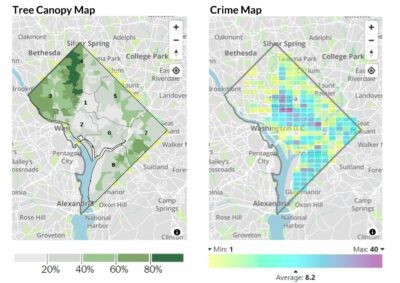
In DC, development is increasingly taking away trees at a time when our communities need them most. Ward 8 has been hit the hardest. Since 2020, Ward 8 residents have lost more canopy to development projects than any other ward, which is especially vulnerable to extreme heat and flooding while simultaneously experiencing some of the highest rates of violent crime. Development doesn’t mean sacrificing our community’s oldest and largest trees and green spaces, and rushed development inevitably costs District residents more than it helps them.
So, while trees aren’t the cure-all for violent crime in Ward 8 or anywhere else, they are undeniably beneficial for both public safety and public health.
Alongside investments in other critical infrastructure – such as community-based violence intervention programs, education, economic development, affordable housing, and youth programs – trees and green spaces can improve public health and support public safety at the same time.