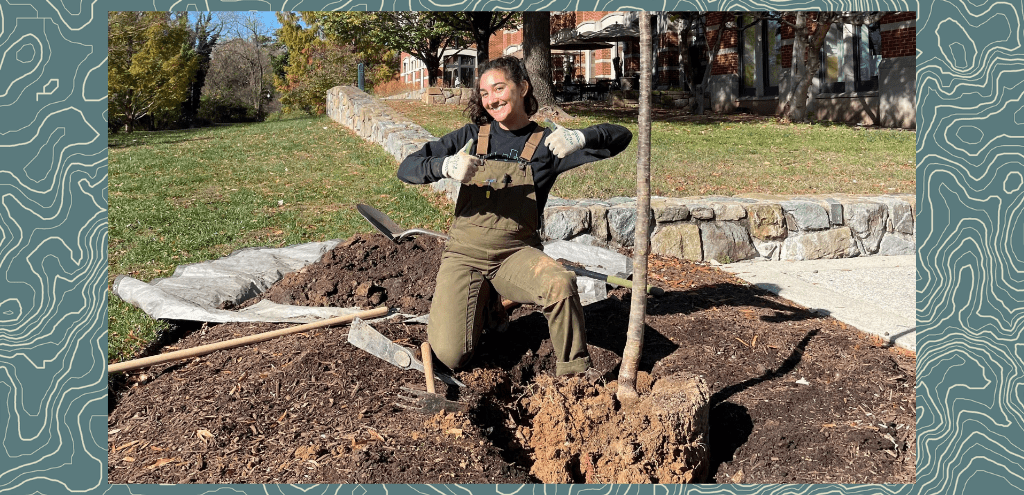
March is Women’s History Month, and we wanted to use this important time of year to highlight Michaila Musman, our Senior Program Manager and a key, longtime member of the Casey Trees team. For over six years, Michaila has channeled her passion and expertise into urban forestry, working tirelessly to advance our mission of restoring, enhancing, and protecting DC’s tree canopy.
Women are increasingly rising in the ranks of forestry, but the stark reality is that fewer than 20% of foresters in the United States are female—a statistic that underscores the ongoing need for diversity and representation in environmental sciences.
We asked Michaila about her journey and insights into a male-dominated field where women are making their mark.
How long have you been with Casey Trees, and what positions have you held?
I’ve been with Casey Trees for just over 6 years now! I started as a GIS Intern after graduating from GWU, then moved into a Program Associate role. From there, I became the GIS Analyst, then the GIS Manager supervising a small team. I’ve been in my current role as the Senior Program Manager for about a year and a half.
How has your role evolved over time?
At first, my role was primarily technical, using paper maps from our foresters to update a digital GIS database with unique locations and info for each tree we planted, and creating maps for internal use. As I got to know our work better, I started working on things like spatial analysis for our land conservation program, StoryMaps to share our data with the public, and doing fieldwork to inventory trees we wanted to collect data on. My role changed again when I began working across the whole organization. I created resources for our tree operations department to streamline operations and used GIS data to determine where in the DMV our tree planting efforts would have the greatest impact. Now, I support the Tree Operations department and the organization in a variety of ways, from procurement to strategy to collaboration with other departments. One of the most important of which is leading our wonderful Data Services team, which handles all things GIS and planting data!
Can you describe a project or achievement you are particularly proud of?
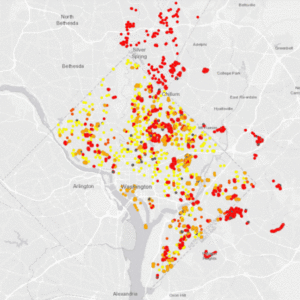
The project that was the most satisfying to finish was definitely our watering map. Working closely with our field manager, I developed an interactive map for our crew to use while watering. While everyone loves planting trees, completing the maintenance to make sure they survive is just as important, so I invested a lot of time and energy into creating something that would help us do that.
Using the map we developed, our crew can select trees on the map and mark them as watered on a specific date. I used a little snippet of code so that adding a water date changes the selected points on the map blue and starts a timer behind the scenes on our map to keep the tree labeled “watered” on the map for two weeks. When that timer is up, the tree turns red again, letting our team know that they should return to give the tree more water. This gives our crew instant info on where they need to direct their watering efforts, and has automated a process that used to be completed with pen and paper.
How did you prepare, learn, and gain experience within your roles here at Casey Trees?
I’ve been lucky to have great mentors throughout my tenure at Casey Trees that have paved the way for me to gain experience. I came into the organization as an intern with some GIS skills and very little experience in urban forestry, and my mentors have given me lots of opportunities to grow in both of those areas. Most of those have come through people asking, “Can we do this better with GIS?” and resulted in my supervisors giving me room to engage in lots of trial and error as well as learn a lot about the GIS tools I had access to through reading, watching videos, and asking people for help. Overall, the skills that I’ve gained at Casey Trees have often come from being comfortable with admitting I didn’t know how to do something, and spending the time and energy to try to meet a goal to learn that new skill.
The forestry sector has historically been a male-dominated profession, with women conservatively making up less than 20% of the workforce. What has been your experience as a woman in forestry?
I’ve been very fortunate to have some exceptional women as mentors and advocates in this field. I think something remarkable about women in the forestry and GIS spaces is that we recognize that we are each other’s best resources. When there is no seat at the table, you can rely on another woman to create one for you. For women in many fields, but especially in the GIS and forestry fields, there’s a lot of imposter syndrome to contend with, and connecting with other women about those challenges is definitely a really important part of feeling like you belong. The community element is key to having the resiliency to walk into male-dominated spaces time and time again and feel confident that you have a unique perspective to offer precisely because you deviate from the cultural norm of that room. The women I’ve met at Casey Trees and through various professional/volunteer channels have all contributed to the confidence I have now.
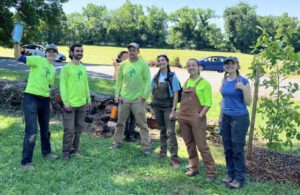
What do you enjoy most about working at Casey Trees?
I find a lot of purpose and joy in working where I live and seeing the immediate and local impact of the work we do. Watching locations around the city transform because of our efforts helps me frame my job as something that is bigger than any personal goal or achievement I have. The people I get to work with are also a huge part of that—I’ve had the privilege of finding collaborators who have become friends I’ll have for many years. Our organization is powered by individuals who come to work every day and do their best for the trees and for the community.
What is the most pressing issue in urban forestry today? How are you helping Casey Trees to meet the challenge?
This answer has changed rapidly over the last few weeks, but in the short term, I have to say that the most pressing issue right now is the huge loss of federal funding that urban forestry programs across the country are facing in the wake of the grants pause. One of my team’s core functions at Casey Trees is to provide data and visualizations that communicate the value of urban trees as essential infrastructure for maintaining healthy communities and cities. During this period of uncertainty, my team and I are continuing to use our resources to help our organization demonstrate why trees are always a good investment.