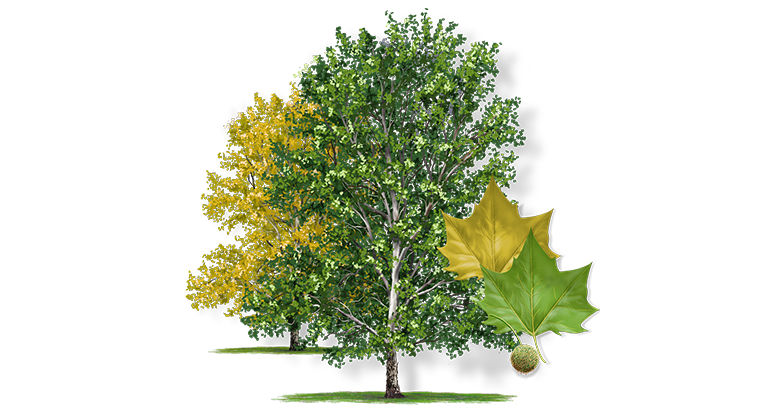
American Sycamore
Introduction
Often called a “camouflage tree” because of its mottled bark and yellow-brown colors in the fall, the American sycamore is an impressive tree that is well adapted to city life and is one of the largest trees in the eastern United States. .
Common Name
American sycamore
Latin Name
Platanus occidentalis
Leaf
Alternate, simple, with 3 to 5 lobes; margins coarsely toothed; broad base
Flower
Ball-shaped, with stickly red-colored petals extending from the surface
Fruit/Nut
Hard, brown, oval/oblong sphere with short soft spikes
Twig/Branches
Zigzag, quite stout and orange-brown in color; leaf scar surrounds the bud and the stipule scar surrounds the twig; terminal bud is absent; lateral buds are reddish, resinous, with a single, cap-like scale
Bark
Thin, mottled brown, green, tan and white; older stems are gray-brown and scaly; often referred to as camouflage and readily exfoliates
Form
Symmetrical canopy with a regular (or smooth) outline, round; spreading; pyramidal
Size
Typically grows 75 to 90 feet tall and 50 to 70 feet wide
Native Range
Grows in all states east of the Great Plains except for Minnesota
Type
Large deciduous tree
Seasonal Colors
Rapidly turns from green to yellow and then brown in the fall
Soil
Grows best in moist or wet alluvial* soils
Light
Prefers full sunlight
Similar Species
London planetree, Oriental planetree, California sycamore
Pests and Diseases
Subject to bouts of anthracnose, causing large leaf falls. Aphids and sycamore lace bugs cause damage but are not fatal; however, bacterial leaf scorch can kill a tree in a few seasons.
Rebate Eligibility
$100
Of Note
It is a member of one of the planet’s oldest clan of trees (Platanaceae) and paleobotanists have dated the family to be over 100 million years old.
Sycamores grow quickly and can live for hundreds of years.
Very often it divides into two or more trunks near the ground and its massive branches form a wide, irregular crown.
Coloring of mottling, leaf teeth/sinuses all different. Seed pods single vs pair in planetree.
Photo Credits
Comments are closed.


